 Blog
Why KYC Verification is Mandatory: Complete Guide for Cooperative Banks, Societies & Institutions
Blog
Why KYC Verification is Mandatory: Complete Guide for Cooperative Banks, Societies & Institutions
Blog
Why KYC Verification is Mandatory: Complete Guide for Cooperative Banks, Societies & Institutions
Blog
Why KYC Verification is Mandatory: Complete Guide for Cooperative Banks, Societies & Institutions
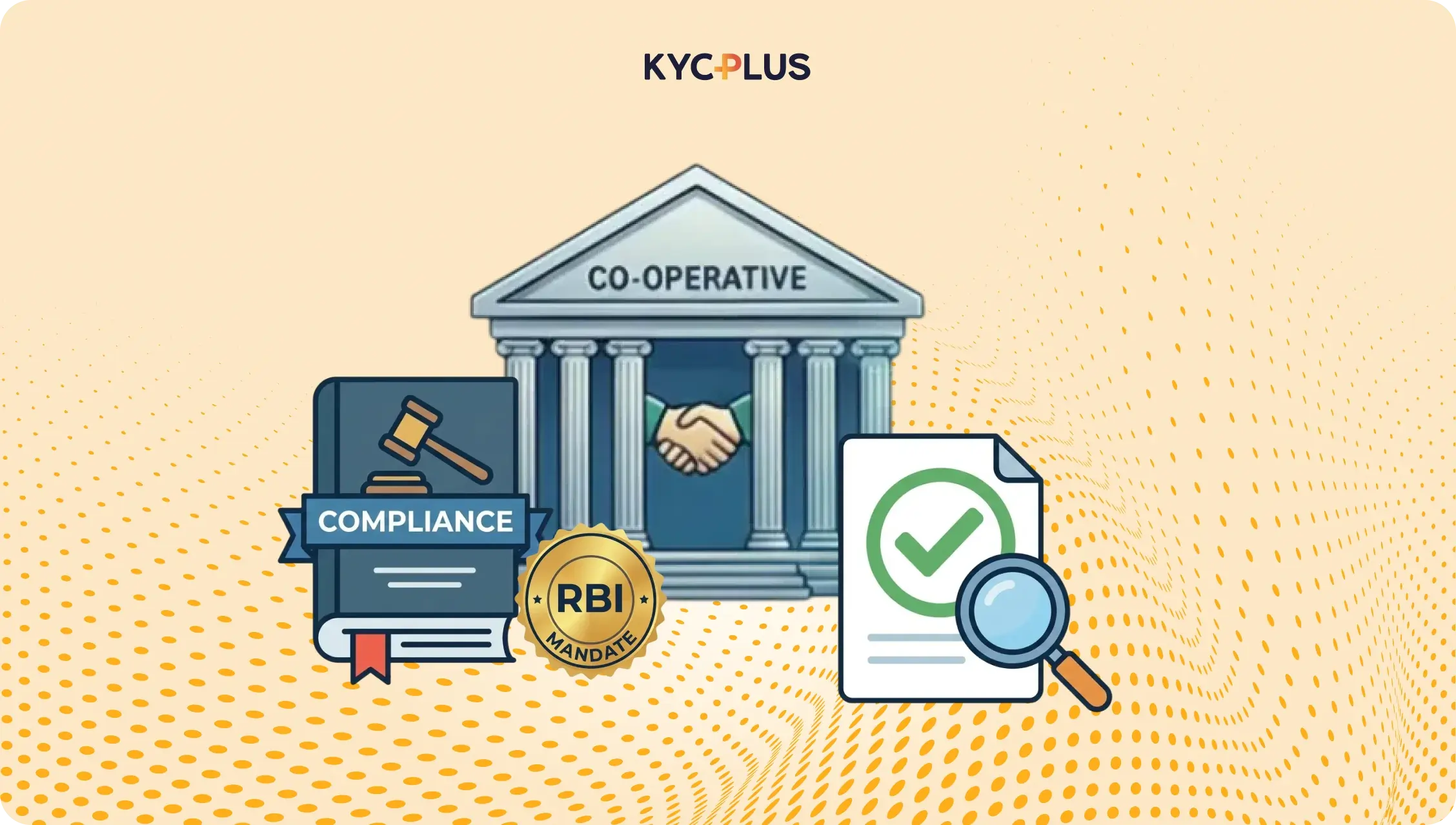
Trust is the backbone of the financial world. Whenever a customer deposits money in a bank or joins a cooperative society, the first question that arises is simple yet powerful: Is my money safe? To answer this, regulators across the globe have established a strong process called KYC – Know Your Customer. In today’s financial ecosystem, whether it is urban cooperative banks, rural credit societies, or large institutions, everyone must understand why KYC verification is mandatory. It is not just a compliance requirement; it is a framework that ensures transparency, security, and long-term trust between institutions and their members.
The Reserve Bank of India (RBI) and other regulators have made it clear: institutions that fail to follow KYC norms face penalties, restrictions, and reputational damage. Non-compliance does not just put the institution at risk; it endangers the trust and safety of every member associated with it.
KYCPLUS acts as a reliable partner for cooperative banks and societies:
KYCPLUS helps institutions implement and understand why KYC verification is mandatory, while making the process seamless and efficient.
Globally, organizations like FATF and the World Bank recognize KYC as mandatory. In India, Aadhaar, PAN, and voter ID integrations have strengthened the process further.
Whether we look at international standards or local cooperative societies, the conclusion remains the same: why KYC verification is mandatory is not just a question; it is the answer to building a secure financial future.
KYC is not just a regulatory requirement; it is the backbone of secure and transparent financial systems. Cooperative banks, societies, and institutions must understand the details of why KYC verification is mandatory, as it directly impacts their credibility, compliance, and customer trust.
One of the strongest reasons why KYC verification is mandatory is fraud prevention. Financial institutions are constantly exposed to risks such as fake identities, forged documents, and fraudulent transactions.
By implementing strict KYC norms, institutions can ensure that every customer is genuine and traceable.
Money laundering is a global issue. Criminals attempt to disguise illegal money by routing it through legitimate institutions. This is exactly why KYC verification is mandatory; to stop such practices.
For cooperative banks and societies, this is critical because they often serve rural populations where awareness is lower, making them easy targets for laundering attempts.
Another major reason why KYC verification is mandatory is to prevent terror financing. Financial institutions must ensure that funds are not diverted to illegal or extremist activities.
Customers trust banks and societies with their personal and financial information. KYC safeguards this trust.
This is another reason why KYC verification is mandatory; it protects both institutions and customers.
The Reserve Bank of India (RBI) has made it clear that KYC is non-negotiable. Institutions that fail to comply face heavy penalties.
This explains why KYC verification is mandatory under RBI rules.
For cooperative banks and societies, trust is everything. Members often belong to close knit communities, and any breach of trust can damage the institution’s reputation.
This is why KYC verification is mandatory for cooperative societies; to maintain transparency and trust.
Implementing KYC can be challenging, especially for cooperative banks and societies with limited resources. KYCPLUS provides solutions that simplify the process:
By using KYCPLUS, institutions can confidently meet compliance requirements and understand in practice why KYC verification is mandatory.
A cooperative bank faced issues with fraudulent loan applications. After implementing strict KYC with the help of KYCPLUS, fraud cases reduced by 70%.
A society in Nagpur adopted digital KYC. Members felt more secure, and regulators praised the institution for compliance.
These examples highlight why KYC verification is mandatory and how KYCPLUS can make compliance easier.
Globally, KYC is recognized as the first line of defense against financial crimes. India has aligned its policies with international standards.
This reinforces why KYC verification is mandatory both globally and locally.
Fraud prevention, money laundering control, terror financing checks, customer protection, and regulatory compliance; all these reasons explain in detail why KYC verification is mandatory. For cooperative banks and societies, the role of KYCPLUS makes compliance easier, faster, and more reliable.
Understanding the legal and regulatory framework is essential to grasp why KYC verification is mandatory. In India, the Reserve Bank of India (RBI), Securities and Exchange Board of India (SEBI), and Insurance Regulatory and Development Authority of India (IRDAI) have all issued strict guidelines to ensure that financial institutions comply with KYC norms. These rules are not optional; they are legally binding requirements that safeguard the financial system.
The RBI has made KYC mandatory for all banks, cooperative societies, and financial institutions.
This explains why KYC verification is mandatory under RBI rules; it is the foundation of secure banking.
For stockbrokers, mutual funds, and investment institutions, SEBI has made KYC compulsory.
This highlights why KYC verification is mandatory even beyond traditional banking.
Insurance companies also follow strict KYC norms.
Thus, across financial services, why KYC verification is mandatory is clear; it protects institutions and customers alike.

India has strengthened KYC by integrating national identity documents.
These integrations make KYC faster, more reliable, and more secure.
Institutions that fail to comply with KYC norms face serious consequences.
This is another reason why KYC verification is mandatory; to avoid penalties and maintain credibility.
For cooperative banks and societies, compliance is even more critical.
This explains why KYC verification is mandatory for cooperative societies; to ensure transparency and protect members.
Implementing these regulations can be challenging. KYCPLUS helps cooperative banks and societies meet compliance requirements with ease.
By using KYCPLUS, institutions can confidently demonstrate why KYC verification is mandatory and how they meet regulatory standards.
Cooperative banks and societies form the backbone of India’s rural and semi urban financial ecosystem. They provide essential services to millions of members who often lack access to mainstream banking. For these institutions, understanding why KYC verification is mandatory is not just about compliance; it directly impacts their credibility, growth, and sustainability.
Trust is the most valuable asset for cooperative banks and societies. Members deposit their savings and expect transparency.
This is a key reason why KYC verification is mandatory for cooperative societies; it strengthens trust at the grassroots level.
Cooperative banks and societies are often targeted for misuse because they serve vulnerable populations.
This explains why KYC verification is mandatory; to safeguard institutions from financial misuse.
Regulators like the RBI closely monitor cooperative banks and societies. Compliance with KYC norms reassures regulators that institutions are operating transparently.
This is another reason why KYC verification is mandatory under RBI rules; it ensures cooperative institutions remain credible in the eyes of regulators.
Despite its importance, implementing KYC is not always easy for cooperative banks and societies.
These challenges highlight the need for solutions that simplify compliance.
KYCPLUS plays a vital role in helping cooperative banks and societies overcome these challenges.
By partnering with KYCPLUS, cooperative banks and societies can confidently demonstrate why KYC verification is mandatory and how they meet compliance requirements.
A cooperative society in Maharashtra struggled with fraudulent loan applications. After adopting KYCPLUS solutions:
This real-world example shows why KYC verification is mandatory and how KYCPLUS makes compliance practical.
The long-term impact of KYC on cooperative banks and societies is profound.
This reinforces why KYC verification is mandatory for cooperative societies; it ensures long-term success.
For cooperative banks and societies, KYC is more than a rule; it is a safeguard for trust, compliance, and sustainability. With the support of KYCPLUS, institutions can overcome challenges and confidently meet regulatory requirements. This is exactly why KYC verification is mandatory for cooperative institutions across India.
The financial sector is undergoing rapid digital transformation. From mobile banking apps to online loan approvals, technology has reshaped how institutions interact with customers. In this new era, understanding why KYC verification is mandatory becomes even more critical. Digital platforms demand stronger identity verification, and cooperative banks and societies must adapt to these changes.
This digital shift explains why KYC verification is mandatory; to ensure that online transactions remain secure and trustworthy.
While digital transformation offers convenience, it also introduces new risks.
These challenges highlight why KYC verification is mandatory despite digital risks.
Using Aadhaar integration, customers can complete KYC online. This method is fast, paperless, and widely adopted.
Introduced by RBI, video KYC allows institutions to verify customers through live video calls. It is secure and convenient for rural members.
Fingerprint and facial recognition technologies ensure stronger identity verification.
These innovations reinforce why KYC verification is mandatory in the digital age.
KYCPLUS is designed to help cooperative banks and societies embrace digital transformation while staying compliant.
By leveraging KYCPLUS, cooperative banks and societies can confidently demonstrate why KYC verification is mandatory in digital operations.
This shows why KYC verification is mandatory and how KYCPLUS enhances the process.
An urban cooperative bank adopted KYCPLUS for digital KYC.
This real-world case highlights why KYC verification is mandatory and how KYCPLUS supports digital transformation.
Digital transformation will continue to evolve. Cooperative banks and societies must stay ahead by adopting advanced KYC solution.
These innovations underline why KYC verification is mandatory for future banking.
Digital transformation has reshaped financial services, but it has also increased risks. Cooperative banks and societies must embrace digital KYC to remain secure and compliant. With the support of KYCPLUS, institutions can modernize their operations while ensuring transparency and trust. This is exactly why KYC verification is mandatory in the digital era.
While the importance of KYC is undeniable, cooperative banks, societies, and institutions often face significant challenges in implementing it. These challenges highlight not only the complexity of compliance but also reinforce why KYC verification is mandatory despite the difficulties.
Many cooperative banks and societies operate in rural and semi-urban areas where internet connectivity is limited.
This is one reason why KYC verification is mandatory despite challenges; to ensure rural members are not excluded from secure financial systems.
Members of cooperative societies often speak local languages and may have limited literacy.
This explains why KYC verification is mandatory; to protect vulnerable populations by ensuring clarity and transparency.
Many rural members lack formal identity documents.
This challenge highlights why KYC verification is mandatory; to encourage members to obtain valid identification and strengthen financial inclusion.
Cooperative banks and societies often have limited staff and resources.
This reinforces why KYC verification is mandatory; to ensure institutions remain compliant even under resource constraints.
KYCPLUS provides practical solutions to help cooperative banks and societies overcome these challenges.
By adopting KYCPLUS, institutions can demonstrate why KYC verification is mandatory while making compliance easier and more efficient.
Challenges such as rural connectivity, language barriers, document availability, and operational burdens make KYC implementation complex. Yet these very challenges emphasize why KYC verification is mandatory; to protect institutions and members from fraud, misuse, and regulatory penalties. With the support of KYCPLUS, cooperative banks and societies can overcome these obstacles and build a secure, compliant future.
The financial landscape in India is evolving rapidly. With digital transformation, fintech innovations, and increasing regulatory demands, the future of KYC is set to become more advanced, secure, and customer-friendly. Cooperative banks, societies, and institutions must prepare for these changes by understanding why KYC verification is mandatory not only today but also for the future of banking.
AI will play a major role in detecting suspicious patterns and fraudulent activities.
This shows why KYC verification is mandatory; to leverage AI for stronger compliance.
Blockchain offers immutable records that cannot be altered.
This innovation reinforces why KYC verification is mandatory for future banking.
Biometric verification such as facial recognition and fingerprint scanning will become standard.
India’s rural and semi urban populations will benefit from digital KYC solutions.
This explains why KYC verification is mandatory; to ensure that financial inclusion reaches every corner of the country.
Regulators like RBI, SEBI, and IRDAI will continue to strengthen KYC norms.
This highlights why KYC verification is mandatory under evolving regulations.
As KYC requirements become more complex, KYCPLUS will play a crucial role in helping cooperative banks and societies adapt.
By adopting KYCPLUS, institutions can confidently demonstrate why KYC verification is mandatory for future banking.
To remain competitive and compliant, cooperative institutions must:
This proactive approach ensures institutions are ready for the future.
The future of KYC in India will be shaped by AI, blockchain, biometrics, and evolving regulations. Cooperative banks and societies must embrace these changes to remain secure and compliant. With the support of KYCPLUS, institutions can modernize their operations and build trust for the future. This is exactly why KYC verification is mandatory in India’s financial evolution.
These points explain in detail why KYC verification is mandatory for cooperative banks and societies.
While KYC is essential, implementation can be challenging. This is where KYCPLUS becomes a trusted partner:
By adopting KYCPLUS, cooperative banks and societies can confidently demonstrate why KYC verification is mandatory and ensure compliance without operational friction.
The future of KYC in India will be shaped by digital transformation, AI, blockchain, and biometric solutions. Cooperative institutions must prepare for these changes by:
This proactive approach ensures institutions remain secure, compliant, and future-ready. After exploring the importance, challenges, and future of KYC, one thing becomes clear: why KYC verification is mandatory is not just a regulatory requirement; it is the foundation of trust, transparency, and security in the financial ecosystem. Cooperative banks, societies, and institutions must embrace KYC as a core part of their operations to protect members, comply with regulations, and build sustainable growth.
These points explain in detail why KYC verification is mandatory for cooperative banks and societies.
While KYC is essential, implementation can be challenging. This is where KYCPLUS becomes a trusted partner:
By adopting KYCPLUS, cooperative banks and societies can confidently demonstrate why KYC verification is mandatory and ensure compliance without operational friction.
The future of KYC in India will be shaped by digital transformation, AI, blockchain, and biometric solutions. Cooperative institutions must prepare for these changes by:
1. Investing in digital infrastructure.
2. Training staff in advanced KYC processes.
3. Partnering with compliance solutions like KYCPLUS.
4. Educating members about the importance of KYC.
This proactive approach ensures institutions remain secure, compliant, and future‑ready.
In conclusion, why KYC verification is mandatory is not just a phrase; it is the guiding principle of modern banking. Cooperative banks, societies, and institutions that embrace KYC build stronger trust, avoid regulatory penalties, and secure long‑term growth. With the support of KYCPLUS, compliance becomes simpler, outreach becomes more effective, and institutions can focus on what matters most: serving their members with transparency and integrity.
Ans: KYC verification is mandatory to comply with RBI, AML, and CFT regulations. It helps cooperative banks and societies verify customer identity, prevent fraud, stop money laundering, and avoid regulatory penalties. Proper KYC also strengthens trust and audit readiness.
Ans: Incomplete or outdated KYC can lead to:
Using KYCPLUS, institutions ensure timely, compliant, and traceable KYC processes.
Ans: KYC requires verification of:
KYCPLUS automates document validation and cross-checks data with trusted government sources.
Ans: Re-KYC frequency depends on customer risk classification:
With KYCPLUS, Re-KYC can be completed digitally, remotely, and with full audit logs—reducing branch visits and manual effort.
Ans: KYCPLUS offers:
This ensures cooperative banks and societies remain compliant, fraud-resilient, and audit-ready at all times.